

Our PhD student Ezgi Özgan presented the poster “Relevance in Imitation: More Than Meets the Causal Eye” (Ezgi Özgan & Jedediah W. P. Allen) at the 2026 IEEE International Conference on Development and Learning (ICDL), held at Kyoto University, Japan, on September 15–18, 2026.
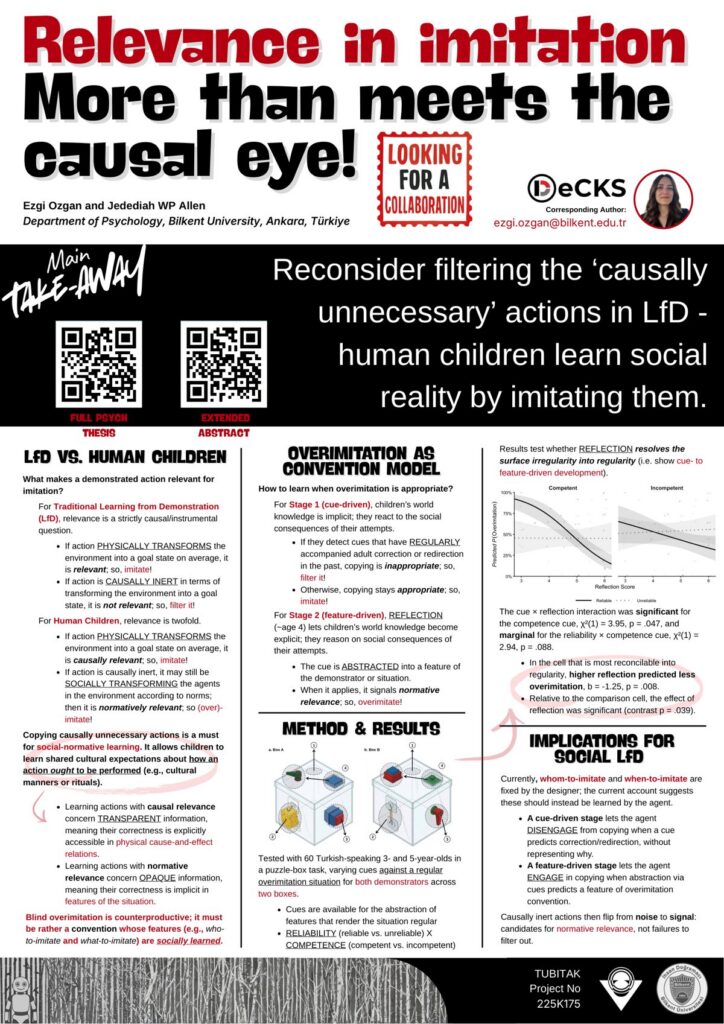
In robotics, learning from demonstration (LfD) treats relevance as a strictly causal question: actions that do not bring about the goal are filtered out as noise. Human children, however, faithfully copy such causally unnecessary actions, a phenomenon known as overimitation. The poster argues that this is how children learn social reality: copying these actions lets them acquire shared cultural expectations about how an action ought to be performed.
Children must also learn when overimitation is appropriate. The poster proposes two stages. First, children react to cues that have regularly come with an adult’s correction. Later, with the development of reflection (around age 4), they abstract these cues into features of the demonstrator or the situation. Testing 60 Turkish-speaking 3- and 5-year-olds in a puzzle-box task, the study found that higher reflection predicted less overimitation in the situation that was most reconcilable into regularity.
For social LfD, this suggests that whom to imitate and when to imitate should be learned by the agent rather than fixed by the designer: causally inert actions become candidates for normative relevance, not failures to filter out.
This work is supported by TÜBİTAK (Project No. 225K175). The poster is available on ResearchGate.